
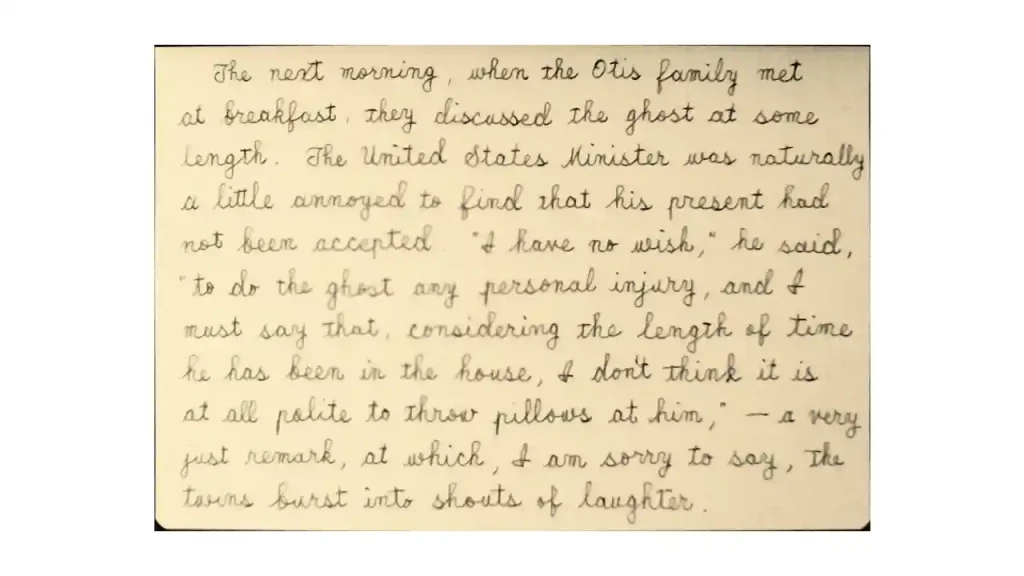
The next morning, when the Otis family met at breakfast, they discussed the ghost at some length.
The Canterville Ghost by Oscar Wilde
Grammar
subject: かれら
predicate: はなしあう
modifier: ゆうれいについて
Japanese Translation
翌朝、オーティス一家が朝食で顔を合わせると、彼らは屋敷の幽霊について話し合った。かなり長く。
- dictionary form
- 顔を合わせる(かおをあわせる, to meet face-to-face)
“かおをあわせる” refers to the act of physically seeing and interacting with someone in person, often implying a direct encounter or confrontation. It can be used in both casual and formal contexts, such as meeting a friend or attending a business meeting.
The United States Minister was naturally a little annoyed to find that his present had not been accepted.
subject: アメリカこうし
predicate: ふきげん
アメリカ公使は自分の贈り物が受け入れられなかったことにすこし不機嫌だった。
- 不機嫌(ふきげん, displeased)
“I have no wish,” he said, “to do the ghost any personal injury, and I must say that, considering the length of time he has been in the house, I don’t think it is at all polite to throw pillows at him,”—a very just remark, at which, I am sorry to say, the twins burst into shouts of laughter.
subject: まくらを・なげること
predicate: れいぎただしくない
「幽霊に怪我をさせたくない。彼はこの屋敷にずっといたのだから、彼に枕を投げることは礼儀正しくない」
とても正しい意見だ。残念な事に、双子はその意見に大笑いした。
- 礼儀正しい(れいぎただしい, polite)
- 大笑い(おおわらい, big laugh)
“Upon the other hand,” he continued, “if he really declines to use the Rising Sun Lubricator, we shall have to take his chains from him.
subject: われわれ
predicate: とりあげる
modifier: くさりを
「他方で、彼が金属オイルを断るなら、彼から鎖を取り上げることになる」公使が言葉を続けた。
It would be quite impossible to sleep, with such a noise going on outside the bedrooms.”
predicate: ねむることが・できない
「眠ることがまったくできない。あんな音が寝室の外でしていたら」
For the rest of the week, however, they were undisturbed, the only thing that excited any attention being the continual renewal of the blood-stain on the library floor.
しかしながら、その週の残りの期間、彼らは悩まされなかった。興味をひくのは、繰り返し現れるライブラリの床の血のシミだけだ。
- 興味をひく(きょうみをひく, to attract interest)
“きょうみをひく” means to capture someone's attention or curiosity, often by presenting something unusual, appealing, or relevant. It implies a pull or draw toward a subject, object, or idea that stimulates thought or emotional engagement.
This certainly was very strange, as the door was always locked at night by Mr. Otis, and the windows kept closely barred.
これは本当にとても奇妙だった。そのドアは常にミスター・オーティスによってカギを掛けられていたし、鉄格子のある窓だったのだから。
The chameleon-like colour, also, of the stain excited a good deal of comment.
それに、カメレオンのようなシミの色は多くの議論を呼んだ。
- 議論を呼ぶ(ぎろんをよぶ, to spark debate)
“ぎろんをよぶ” means to provoke discussion or disagreement among people, often by introducing a controversial, complex, or thought-provoking topic. It implies that the subject has enough weight or ambiguity to generate differing opinions and active conversation.
Some mornings it was a dull (almost Indian) red, then it would be vermilion, then a rich purple, and once when they came down for family prayers, according to the simple rites of the Free American Reformed Episcopalian Church, they found it a bright emerald-green.
ある朝、その色はぼんやりとした赤色だった。
それから、朱色になり、鮮やかな紫色になった。
そして、オーティス一家が祈りに下りてきた時には、シミは鮮やかなエメラルドグリーン色だった。
These kaleidoscopic changes naturally amused the party very much, and bets on the subject were freely made every evening.
その変化は一行を大いに面白がらせて、それについて自由に賭けが行われた。毎晩。
The only person who did not enter into the joke was little Virginia, who, for some unexplained reason, was always a good deal distressed at the sight of the blood-stain, and very nearly cried the morning it was emerald-green.
その悪ふざけに参加しなかったのは、リトル・ヴァージニアだけだった。何らかの理由で、彼女はいつもひどく悲しんでいた。血のシミの光景に。
エメラルドグリーン色だった朝、彼女はもう少しで泣くところだった。
Referenced from: The Canterville Ghost by Oscar Wilde